










The one sentence from Powell that could ruin the holidays.
Welcome to a critical week for your portfolio. We find ourselves staring down the barrel of the final Federal Reserve meeting of the year. While many of us are busy untangling holiday lights or figuring out if eggnog actually tastes good, the biggest event on the calendar is happening right in Washington D.C. The Federal Open Market Committee is set to meet this Tuesday and Wednesday.
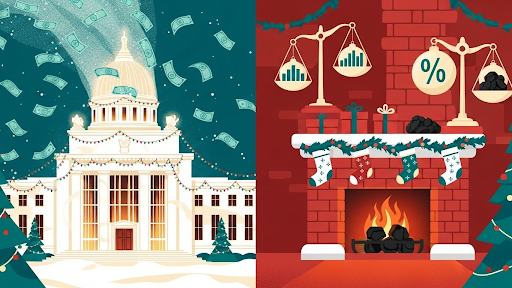
The stakes are exceptionally high this time around. We are looking at a market that is hovering near record highs, desperate for a reason to break through the ceiling. The narrative right now is a battle between receiving a lovely gift in the form of a rate cut or getting a stocking full of coal if the central bank decides to tighten its grip. It is a fascinating setup where the actual decision might matter less than the tone used to deliver it.
In this edition of The Market Pulse, we are going to dissect exactly what is happening with the Fed. We will look at why 2026 projections might be the real story rather than what happens this month. The goal is to navigate this week with clarity rather than anxiety. We want you prepared for the headlines that will inevitably splash across your screen on Wednesday afternoon. Let us get into the details and prepare for the week ahead.
This Week I Learned…
The Technical Truth of the Holiday Rally
You hear the term thrown around constantly on financial news networks every December. Everyone talks about the “Santa Claus Rally” as if it simply means stocks go up because people are in a festive mood or spending money on gifts. However, I learned this week that the term is far more specific and technical than just “a good month of December.”
The term was officially coined by Yale Hirsch, the creator of the Stock Trader’s Almanac, way back in 1972. It does not refer to the entire month. Instead, it specifically describes the stock market performance during the last five trading days of the current year and the first two trading days of the new year. This is a very narrow seven-day window.
Why does this specific window matter? Theories suggest it is due to a combination of tax considerations, general optimism, and the investing of holiday bonuses. Another factor is that many institutional investors and “bears” are on vacation during this week, leaving the market to retail investors who tend to be more optimistic or “bullish.”
Statistically, the S&P 500 has gained an average of 1.3% during this seven-day period since 1950. It is a reliable indicator too. Hirsch famously noted that if this rally does not occur, it often predicts a bear market or a flat year ahead. He even created a rhyme for it: “If Santa Claus should fail to call, bears may come to Broad and Wall.” So when you watch the markets later this month, remember that the real test has not even started yet.
The Fun Corner
The Oracle of Volatility
We often look to market experts and central bankers as if they possess a crystal ball that can predict the future with perfect clarity. The reality is often much funnier.
Here is a bit of trivia regarding market forecasting that should make you feel better about your own guessing game. There is an old Wall Street saying that goes: “The stock market has predicted nine of the last five recessions.”
It highlights how the market often reacts in panic to events that never actually turn into economic downturns. But let us look at the “January Barometer.” This is the theory that as the S&P 500 goes in January, so goes the year. While it has a decent track record, it is famously wrong during the years when you need it most.
In 2026, or any future year, if an analyst tells you they know exactly where the S&P 500 will end the year, just remember that the average “expert” forecast usually misses the actual mark by double digits. The only certainty in the market is that it will fluctuate. So if the Fed Chair speaks this week and the charts start looking like a jagged mountain range, just smile. It is the only thing the market knows how to do perfectly.
The Fed’s December Dilemma
The Federal Reserve is holding its final policy meeting of the year on December 9 and 10. This event is the primary driver of market sentiment right now. The big question is whether investors will get the rate cut they are hoping for or if the central bank will dampen the holiday spirit.
Currently, the market is pricing in an approximately 87% chance that the Fed will lower interest rates by 25 basis points. This optimism has helped push the S&P 500 back toward record highs after a brief dip in November. The government shutdown fears have subsided, and economic data has resumed flowing, which supports the argument for easing monetary policy. However, the cut itself is arguably already priced into the stock prices we see today.
The real news on Wednesday will likely not be the rate cut itself, but rather the Summary of Economic Projections. This document includes the “dot plot,” which shows where Fed officials expect interest rates to be in the coming years. Investors are now hyper-focused on the projections for 2026. Market participants want to know if the Fed anticipates aggressive cutting over the next two years. If the Fed projects fewer cuts than the market expects, it could cause a sharp repricing of assets.
Furthermore, Federal Reserve Chair Jerome Powell’s press conference will be scrutinized for tone. If he sounds doubtful about future cuts, it could throw cold water on the rally, similar to what happened after the December meeting last year. AI-driven models and options traders are already signaling potential volatility, with significant swings expected in the S&P 500 immediately following the meeting. Institutional investors are wary of a “buy the rumor, sell the news” scenario.
While the short-term reaction might be bumpy, many strategists argue that the long-term trend remains positive. As long as the Fed is generally on a path to lower rates and the economy avoids a major shock, the bulls may still have the upper hand going into next year.
The Last Say
Rates, Rally, Volatility
We have covered a significant amount of ground regarding the upcoming Federal Reserve meeting and the expectations surrounding it. It is clear that this week is pivotal. The combination of interest rate decisions and the release of economic projections for the next few years creates a perfect storm for potential market movement.
The key takeaway for this week is to avoid knee-jerk reactions. Wednesday afternoon will likely bring noise and rapid price changes as algorithms and traders digest the new data points. Remember that one meeting does not make a trend. The broader view suggests that we are still in an environment where rates are likely to come down over time, even if the pace is slower than some aggressive bulls would prefer.
Keep an eye on the labor data coming out on Tuesday and Thursday as well, as these numbers often influence the Fed’s thinking just as much as inflation reports do. Patience is your best asset during weeks like this. Watch the headlines, understand the context we discussed today, and stick to your long-term plan. We will see you on the other side of the announcement.