


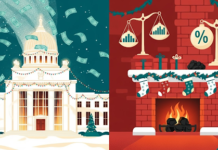










The Fed, The Data, and The Friday Shake-up
Welcome to the middle of December. Usually, this is the time when trading desks grow quiet, volumes thin out, and everyone mentally checks out for the holidays. However, 2025 has decided to keep us on our toes until the very last second. We are looking at a week that is anything but sleepy. Thanks to the backlog from the government shutdown earlier this fall, we are facing a deluge of data that should have arrived weeks ago. It is a bit like receiving your credit card bill three weeks late. The damage is already done, but you are only just now seeing the numbers.
We have a delayed jobs report, a critical inflation reading, and a massive index rebalance all crammed into the next few days. It is the financial equivalent of last-minute holiday shopping in a crowded mall. The market is trying to figure out if we are ending the year with a celebration or a headache. While the volatility might tempt you to click buttons and move money around, seasoned pros are suggesting a different approach. Sometimes the smartest move is to do absolutely nothing at all.
This Week I Learned…
The Mechanics of Index Rebalancing
This week, we are looking at something that happens quietly in the background but moves billions of dollars in seconds. We are talking about Index Rebalancing. You might hear about this happening on Friday regarding the S&P 500 and the Nasdaq-100. But what actually happens?
Think of an index like a very exclusive VIP guest list for a party. To stay on the list, companies need to meet certain criteria regarding value and profitability. Every quarter, the bouncers (index providers like S&P Dow Jones) review the list. Some companies get kicked out, and new ones get invited in. Furthermore, the “weight” of each guest changes. If a tech company’s stock price doubled since the last meeting, it now takes up more room in the index.
Here is why it matters to you. Trillions of dollars in ETFs and mutual funds are passively managed. They are legally required to own exactly what the index owns. When the index changes its list on Friday, every single one of those funds must buy the new additions and sell the removals at the exact same time. This creates one of the biggest liquidity events of the year. It forces massive trading volume regardless of market sentiment or economic news.
For an individual investor, this often results in strange price movements at the end of the day that have nothing to do with news and everything to do with fund managers scrambling to match their spreadsheets. Now you know that when you see a sudden spike in volume this Friday close, it is just the passive funds rearranging the furniture.
The Fun Corner
The Reality of “Long Term” Investing
Investing requires patience, strategy, and a cool head. However, human nature often gets in the way of those noble goals. There is an old observation among traders that is particularly relevant as we approach the end of the year and review our portfolios.
Two investors are looking at a screen. One points to a stock that has dropped 15% in two weeks and asks his colleague what his strategy is for that specific ticker.
The colleague sighs, adjusts his glasses, and says, “Oh, that one? That is a long-term investment.”
The first investor looks confused. “I thought you bought that for a quick swing trade on the earnings report?”
“I did,” the colleague replies. “But then the price went down, I refused to sell, and now it is officially a long-term investment.”
It is a funny reminder that the difference between a trader and an investor is often just a matter of how red the position is. Remember to stick to your thesis this week!
The Year-End Data Deluge
We are entering the final stretch of 2025, and the stock market is preparing for a significant stir-up. Investors hoping for a quiet coast into the New Year will be disappointed. A barrage of economic data is about to hit the wires, headlined by the delayed November jobs report and a crucial inflation reading. These reports were held up by the government shutdown, meaning we are flying blind until the numbers drop.
The stakes are high. If the unemployment rate accelerates above 4.5%, it could force the Federal Reserve to adjust its outlook for 2026. Currently, the central bank is signaling a patient stance, with interest rate cuts proceeding slowly. However, weak jobs data could fuel expectations for a faster rate cut in January. Conversely, if the data comes in strong, the Fed might hit the pause button to ensure inflation does not reignite.
Adding to the complexity is the Consumer Price Index (CPI) report due this week. While inflation has been cooling, the market is sensitive to any surprises. Economists expect a 3.1% year-over-year rise. Yet, many experts argue that investors should take these numbers with a grain of salt. Because the data is backward-looking and delayed, it might not accurately reflect the current economic reality. The narrative for 2026 remains focused on moderate growth, assuming no major derailments occur.
Beyond the economic reports, Friday marks a massive quarterly index rebalance for the S&P 500 and Nasdaq-100. This is a major liquidity event where funds reshuffle billions to align with benchmarks. It is a technical phenomenon, not a fundamental one.
So, what should you do? Market veterans are loud and clear: do not panic. This is not the time for “window dressing” or making last-minute changes just to make your portfolio look busy. Unless there is a fundamental change in your holdings, trading for the sake of trading is a mistake. The smart money is staying neutral, balancing exposure, and waiting for the dust to settle before making big moves for 2026.
The Last Say
Closing the Books on 2025
As we wrap up this edition of The Market Pulse, the message for the week is centered on discipline. We are facing a unique convergence of events. You have old data finally seeing the light of day, combined with the mechanical churning of the index rebalance. It creates a foggy environment where price action might not tell the whole truth.
The delayed jobs and inflation reports are important, yes. They provide the final pieces of the puzzle for 2025’s economic picture. However, remember that markets are forward-looking mechanisms. Wall Street is already looking past these backward-looking numbers and trying to price in the reality of 2026. The consensus seems to be shifting toward a year of moderate growth where the Fed becomes less of a central character.
Your goal this week is to distinguish between noise and signal. The volume spike you see on Friday is likely just noise—technical funds doing their required chores. The delayed data is the signal, but it is a signal from the past. Anthony Saglimbene from Ameriprise suggests using this time to find a neutral stance. You do not need to be a hero in the final two weeks of the year.
If you have held your positions through the ups and downs of 2025, patience remains your best asset. Let the institutions fight over the liquidity on Friday. You can sit back, watch the numbers roll in, and start planning your strategy for a fresh start in January.